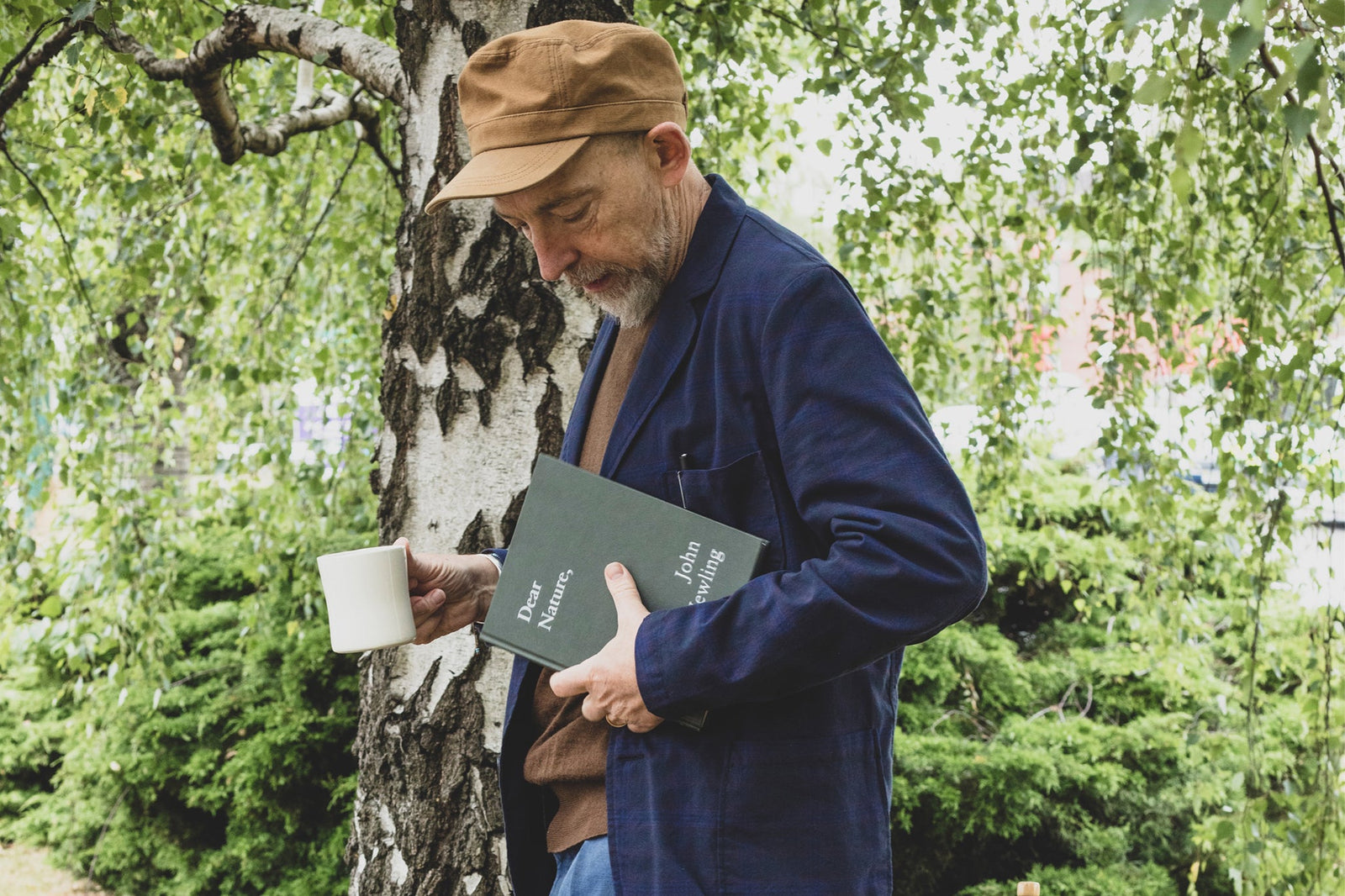
We are always inspired by the art and music that we discover on our travels and lucky enough that people around the world share great work with us!!
This month we’re close to home, as our friends at Beam Editions have launched a Kickstarter Campaign to fund a new book, Dear Nature by the Nottingham based, International recognised, artist John Newling.
Like the road trip that inspired this season's collection, John Newling began his career traveling and making artworks in California and the South West in the early eighties as part of his Fulbright Fellowship. He’s since gone on to exhibit his artwork around the world and currently has a major exhibition at the Ikon Gallery in Birmingham which we’re hoping to see when it re-open mid-July post lockdown (hopefully).
Born in Birmingham in 1952, John Newling’s artwork is centered around observing and understanding Nature and championing a more sustainable world. Over the last 15 years, he’s been busy growing plants in his home studio and garden and integrating them into his dazzling paintings and reliefs. In recent years he’s created artworks from growing and pressing the leaves of traditional jersey kale cabbages, whose stalks are so strong that they are traditionally used to make walking sticks, the tropical Moringa Oleifera or Miracle Tree, thought to be the most nutritious plant in the world and more recently he’s been growing flax, traditionally grown in Northern France and Belgium to make the world's finest linens.
For his new book, Dear Nature John wrote 81 letters ‘to nature’ in 81 consecutive days. The letters take us on a journey that explores our relationship within nature and how we can create a better future, certainty something we all need to consider. The book is beautifully designed and illustrated with each page showing flax plants at the different stages of growth over the 81 days. We think this is a great book with a great message so get behind the campaign and help make the project a success.
Here are some readings from the made by the artist.
Made by filmmaker Reece Straw.
You can read more on how to support the kick-starter project here.
Sign up to our newsletter.
To learn more about us, take a look behind the scenes, and be the first to know about collabs and launches, subscribe to our newsletter here.
You can buy a digital gift card here. They can be used on our website or in our retail stores. Please bear in mind that gift cards are only available to UK customers at present and expire 2 years from the purchased date.
There is no right way. The chore jacket began as a practical garment, a layer worn over everyday clothes, it has never been defined by a particular fit. Some people prefer a neater fit, worn almost as a blazer, while others size up to allow for knitwear and heavier layering underneath. What matters is ease of movement, comfort, and the feeling that it belongs naturally with the rest of your wardrobe.Whether worn with jeans, fatigue pants or as part of a casual suit, a good chore jacket should feel easy to wear and easy to make your own. It can be dressed up or down, layered over a T-shirt or a shirt and tie. That versatility is part of its appeal, and probably one of the reasons it has outlasted so many trends.
There are no hard rules. The beauty of an overshirt is that it is one of the most adaptable pieces in a wardrobe, sitting somewhere between a shirt and a jacket and happily performing as either. Some of our overshirts lean closer to traditional shirting. Worn open over a T-shirt, they can feel a little more considered than a shirt with a two-piece collar.Others take their cues from workwear and function more as a lightweight alternative to a jacket when the weather allows. Wear it open, wear it buttoned up, layer it under a coat or throw it on in place of a jacket. They all share the same useful quality of adaptability. Equally comfortable with a T-shirt, knitwear or tailoring, an overshirt tends to find its own place in your wardrobe.
It is a fair question. After all, any shirt worn over a T-shirt could claim to be an overshirt.An overshirt is one of those garments that is easier to recognise than define. For us, an overshirt occupies the space between a shirt and a jacket, although it generally leans toward the jacket side. Our earliest versions were essentially chore jackets made from lighter-weight cloth, creating an uncomplicated layer. They offered the practicality and ease of a jacket without the structure.Today, some of our overshirts still resemble simplified jackets, while others retain the details of traditional shirting but are made from fabrics with enough substance to be worn as outerwear. Since then, the category has expanded in two directions. Some of our overshirts remain distinctly jacket-like, with patch pockets and simple workwear styling. Others borrow more from classic shirting, but are cut from sturdier fabrics that make them ideal as an outer layer.If "overshirt" feels a little vague, that's because it is. We simply think of them as versatile pieces that can be worn as either a shirt or a jacket, depending on the season, the fabric and how you choose to wear them.
The name ‘chore’ comes from the everyday jobs, or “chores” that this style of jacket was made for. Before workwear was a sought after style, it was simply what you put on to get something done, or to keep your own clothes clean while you did it. The chore jacket, in both name and style, is derived from this workwear heritage.Most versions of chore jackets share the same make-up: hard-wearing cotton or drill, a button front, and big patch pockets sized for tools, a notebook or lunch. Different countries historically had their own specific take on this. The French had the bleu de travail, the blue cotton jacket worn across their labour force; America had its chore and engineer's jackets; and plenty of British trades wore something close to both. So many have worn a version of the chore jacket that it has become a sort of unofficial uniform of workers, makers and artisans the world over.
What is unique about Universal Works' chore jackets?
Our mainstay chore jacket is the Bakers Jacket. The name is in homage to a baker, our founder's father, who wore a coverall to work every day. It has been our staple since the first collection: chore-styled, buttoning to the neck in a coverall way, but made to be worn where you would wear an ordinary collared jacket. Its defining feature is the slanted buttonhole on the front stand, a nod to the pocket watch chains once worn by workers. Five patch pockets, including a stitched-through internal chest pocket and a lower pocket with additional internal compartment, which add both function and character. Front and back panelling brings shape and structure, setting it apart from the simple coveralls that inspired it.Over the years our Bakers chore jacket line has grown into a small family: Original Bakers, Bakers OG, Simple Bakers, into Labour, Field and the shorter, flap-pocketed Warmus and Franck.Read the full story of the name in our Journal: Why's it called a Bakers Jacket?